I spoke at the 2020 Friends Of Kloofendal annual general meeting. I had a few requests for a copy of the presentation. Instead of emailing text, I recorded an audio file of the presentation.
There is pattern, and a common trend in the way that we abuse the environment for profit; something that was written about almost 200 years ago.
In 1833, William Forster Lloyd published an article in which he described the effects of the overuse of a common resource. In the early 1800’s, common land was used by herders to graze their cattle, for which they derived a free benefit. A herder could get more benefit from this arrangement, if more of his cattle were moved onto the land. However, there was a tendency for herders to graze too many cattle, which resulted in overgrazing and the destruction of the common resource. In this scenario, the land was degraded and rendered unusable beyond recovery.
Further to Lloyd’s article, in 1968, ecologist Garett Hardin wrote a paper entitled ‘The Tragedy Of The Commons”. In his paper, Hardin re-conceptualised the “commons” to be any kind of free, shared and unregulated resource, illustrating how mankind damages these resources through exploitation and greed. Modern examples of free resources that succumb to the tragedy of the commons include:
Tragedy of the commons can be described as having your house broken into many times by a thief. The first time, the thief breaks into your house and steals the most valuable and easily removed items. Your TV, jewellery, cash, cellphones and cameras. The thief noticed other items of value, so a few weeks later, he breaks in again, and steals these items. The third time the thief breaks in, he steals yet more items. Eventually, all the items of value have been stolen. This process of taking the most valuable items first, and then moving on to the next most valuable items, is called serial depletion.
In some instances, complex social schemes such as the Kyoto Protocol, Paris Climate Agreement, United Nations, CITES (Convention on International Trade in Endangered Species), marine reserves and national parks have been implemented to protect the environment from exploitation. Public interest groups may lobby governments into taking action against guilty organisations. The rise of social media and monitoring organisations such as Greenpeace, Oceana, World Wildlife Fund and Wikileaks are powerful platforms to express contempt and expose how some organisations do business when they think no one is looking.
The miracle of nature is that whenever there has been a challenge, there is an organism that has found a way to conquer it. There are an estimated 30 million plants and animals on Earth which are essentially individual science experiments, perpetually testing out new ways of doing things in order to find a better way.
After 4.8 billion years of natural capital accumulation, nature has come up with some ingenious ways to deal with some of life’s most pressing challenges. Since humans live under the same laws of nature and under the same conditions, it makes sense that we learn from the inner workings of the natural world.
In order to be truly innovative, we must look beyond our limited understanding of the world around us. If we lack the fundamental understanding of the natural world, we will never see the opportunities that nature has to offer. However, in order to be open to the possibilities that nature provides and begin to build a new sustainable world, we must not lose sight of the following:
The focus on Nature as a source of innovation has been formalised through the practice of biomimicry and the science of biotechnology. There is no doubt that we have much to learn from this 4.8 billion year old jigsaw puzzle that is the world we live in today.
Biomimicry and biotechnology promise to solve some of our greatest problems. However, we have to change the way we identify value in the world in order to see the unlimited possibilities that are all around us. Ironically, it is often the most unlikely animals and plants that have provided us with the greatest technological breakthroughs.
Another area of great interest is the application of biological aspects of nature to create new technologies. New technologies are being discovered from areas of the natural world that we once thought were of no benefit to mankind. It is an exciting field of study simply because it is limited only by our imagination and the ability to identify solutions hidden within the natural world.
The study of venoms has developed into a formal field of research. This focused interest is fuelled by the possibility of discovering revolutionary medical science through venoms and their individual components. With over 100,000 different venomous animals in the world the opportunities for developing new biotechnology is almost unlimited.
The indian cobra (Naja naja) is responsible for thousands of deaths per year in India. However, according to research, its venom holds the secret to treat a disease that affects more than 350 million people worldwide: Arthritis.
The venom of the wandering spider (Phoneutria nigriventa) in South America has aroused a great deal of the interest. In male patients, the bite from this spider cause long lasting erections. Considering that Viagra sales in 2015 topped $1.7bn, the venom from this spider is something to get very excited about. It is estimated that in 2019, the market value for these drugs will be $3.4bn. Imagine if mankind could isolate and replicate the responsible component.
Components of black mamba (Dendroaspis polylepis) venom have been isolated to produce some of the worlds most effective pain killers that have no side effects and are up to 7 times more effective than morphine.
Venom from the death stalker scorpion (Androctonus crassicauda) is being used to treat certain cancers as well as Alzheimer’s disease.
The gila monster (Heloderma suspectum) is a venomous lizard from northern America whose venom is being used to create a treatment for diabetes. The World Health Organisation estimated that there were 422 million people with Type 2 diabetes in 2014.
The naturally occurring components of venom provide a convenient point of origin. Once we have a basic understanding of how these venoms “work”, we have a clue to their application. The components of these venoms can then be artificially synthesized and manufactured.
Spider silk has been given much attention over the past few years. It is antibacterial, it can stretch over 300% of its own length, and with a higher tensile strength than steel, it is in a class of its own. The Canadian company Nexia, has developed genetically modified goats that produce spider silk proteins in their milk. Although this has solved the problem of producing spider silk in large quantities, the project failed to produce an end product as they couldn’t realign these proteins into fibres.
In the 1800’s, life expectancy of the average person was only 36. After Scottish scientist Alexander Fleming discovered the properties of penicillin mould in 1926, life expectancy increased to 50.
Other examples of biotechnology include:
The elegant design of nature offers inherent solutions to natural problems. However, we must be careful to use biotechnology only in its original and pure form. Tampering with nature at a genetic level has already caused unexpected consequences that have resulted in harmful knock-on effects.
History has taught us is that trying to improve on nature often results in unintended consequences. Biotechnology from genetically modified organisms poses a threat to biodiversity and raises many ethical questions regarding the way it is created, marketed and consumed.
The human population has been increasing at an alarming rate. From 1804, it took just over 100 years for the human population to increase from 1 billion to 2 billion in 1927. In 2016, it was projected that we will increase our population by 1 billion in about 12 years. This exponential growth is having a dramatic adverse impact upon our planet. Many authors have compared this increase of the human race to a virus. Indeed, it does show many of the characteristics of a virus in the way that it replicates and how it affects its host (the Earth).
When other animal populations reach the upper end of their limits, a natural and controlling force steps in. Limited food source, disease and self regulation keep populations in check. Humans however, have been blessed (or cursed?) with the “intelligence” and aptitude to bend these limiting natural forces.
According to the annual United Nations Human Development Report, in 1990 we crossed an invisible line when our consumption of resources equalled the resources that the Earth provided. We were living at the very tipping point of sustainability. In 2005, research by the United Nations concluded that the rising human population and over consumption of resources had polluted or over exploited two-thirds of the Earth upon which life depends.
There is a basic equation that states that in order for human civilisation to continue along this path, our consumption must equal or be less than available resources. In the year that I was born, in 1970, there were about 65,000 black rhinoceros in the world (in 2016 there are about 3,500); the Beetles split up; Jimi Hendrix died; IBM introduced the floppy disc; barcodes were introduced into supermarkets; LCD screens were invented; and the world’s population was a mere 3.7 billion people almost half of what it is today in 2017.
The world is changing at an ever-increasing rate. Of all the children entering primary school today, 65% will end up working in jobs that currently do not exist.
Many feel that the world is already overcrowded, but consider that by 2050 there will be a projected 9.2 billion of us. Where will these additional people live and what will their impact be? Frightening questions that our children will have to grapple with.
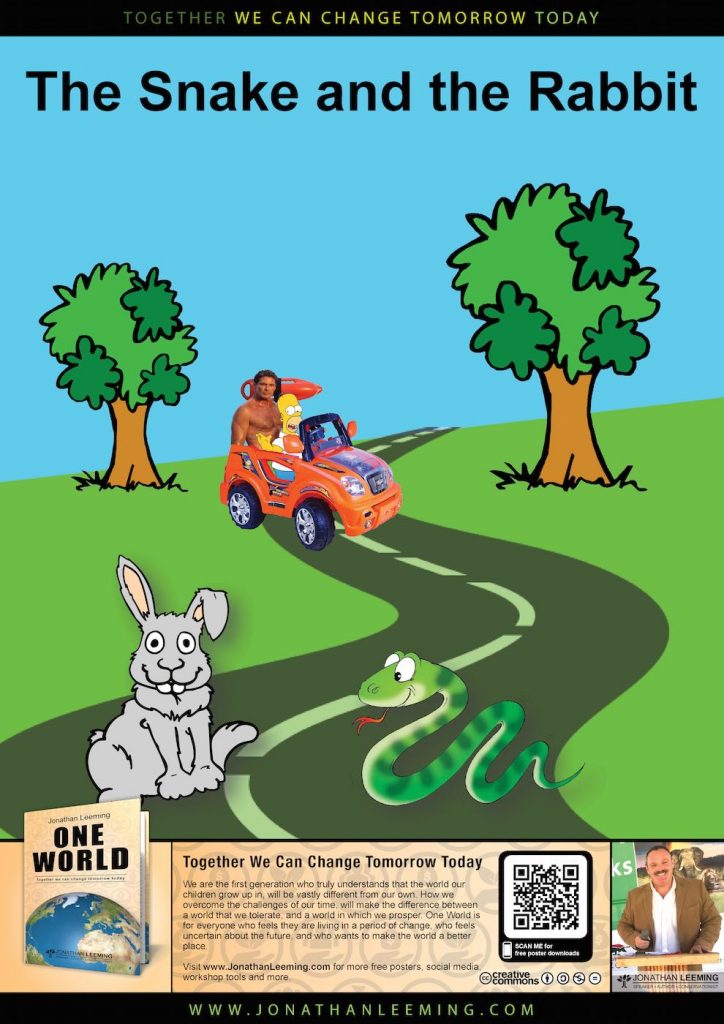
Imagine that you are driving your dream car down a dark and misty road. You could be driving anything from a Prius, to a Hummer. All of a sudden, from the left a fluffy bunny rabbit jumps into the road, and from the right a snake slithers into the road. What do you do?
If you swerve to avoid the rabbit, you’ll kill the snake! If you swerve to avoid the snake, you’ll kill the rabbit! If you do nothing at all, you’ll kill both of them!
The snake and the rabbit analogy illustrates the journey of your life and the decisions that you make everyday. Your dream car is the technology that you use, and how you drive it relates to how you consume, and how our decisions are driven by our values and beliefs. If you imagined yourself driving a Hummer, your ecological footprint is greater because of the petrol guzzling engine, its large and lumbering size, all the fancy shiny trim and the wide tyres. If you imagined yourself driving a Prius, your ecological footprint will be lower because of its hybrid engine, smaller size and narrow tyres. Both vehicles will get you to and from a destination and both vehicles have an impact.
It helps us understand how we are driven by our values and beliefs, the impact that we have upon the world and the consequences of our every day choices. To most people, the snake is a vile and evil creature to be feared and killed. When compared to a fluffy bunny rabbit, the snake will usually come second.
In the snake and the rabbit analogy, sometimes we kill the snake, sometimes we kill the rabbit, and other times we just run everything over. However, there is another choice that we all need to be aware of. We should rather drive the car paying close attention to every obstacle that comes our way, taking corrective action or stopping to let the rabbit and the snake both cross the road.
We have to be aware that our everyday actions have the power to change the world in a positive or in a negative way. We also have to realise that killing the snake or the rabbit, or both, is a choice. A choice that we each have to make.
We don’t have to buy plastic grocery bags. We don’t have to water our garden with drinking water. We don’t have to leave the lights on in unoccupied rooms. These are all choices that we make, and all of these choices have consequences.
As the dominant animal species on Earth, we have the moral obligation to future generations to look after the world we live in and to conserve all aspects of the environment. However, in accordance with our own set of values and beliefs, we conserve some aspects more diligently than others.
I spoke at the 2020 Friends Of Kloofendal annual general meeting. I had a few requests for a copy of the presentation. Instead of emailing text, I recorded an audio file of the presentation.
It was a chance to inspire and educate the next generation of conservationists and underpin the importance of insects in the greater scheme of things.
Just as a spoiled child demands a new toy or a bar of chocolate at the checkout counter, mankind has viewed natural resources with much the same childish bravado. The temptation to desire something, or to exploit a resource as we see fit, is justified by the human perception of ownership. In our attempts to […]
When I was growing up in England in the 1970’s I, like everyone else at that time, watched the news on TV before dinner. From Ethiopians starving to death in their war-torn country, commercial loggers chopping down the Amazon rain forest, and Green Peace harassing Japanese whaling ships, it seemed terrible that mankind could inflict […]
The question of how much do we impact upon the environment can be tricky to answer, simply because we are rarely cognisant the consequences of our actions. So much of our impact is hidden from us either through society, or by the organisations who manufacture the products that we use. For example, consider where your […]
Sustainability is a journey that consists of a bold series of steps that are built on change management, innovation and responsible leadership. It is not something that just happens overnight, but rather a process that all organisations and individuals must undertake.A few years ago, I was taking out my rubbish for collection and decided to […]